
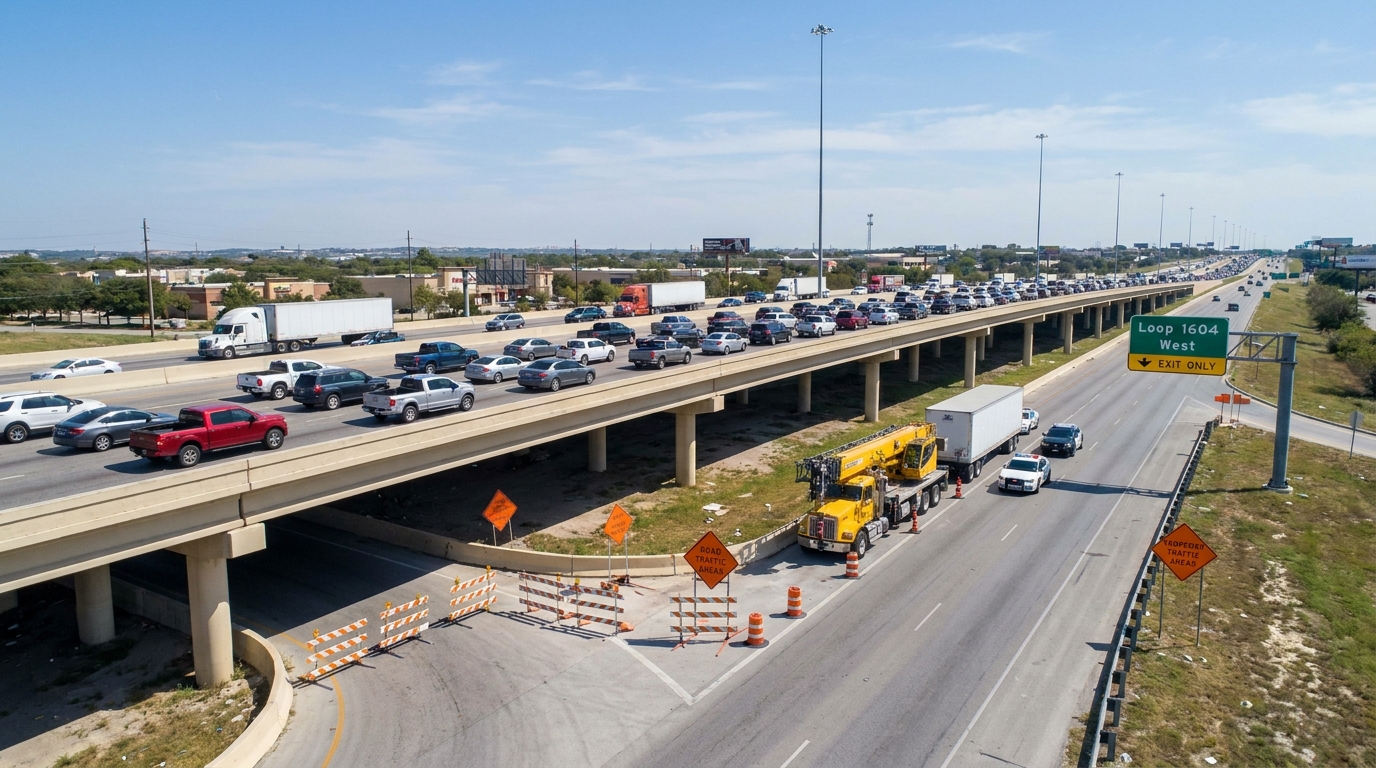
A major commercial-vehicle crash on Loop 1604 East on Tuesday, April 28, 2026, highlights critical safety concerns for San Antonio families. According to KSAT, Converse police reported that a crane truck and an 18-wheeler collided near Rocket Lane after a tire allegedly detached from the crane truck, causing the driver to lose control. This incident underscores how catastrophic truck crashes often begin with preventable maintenance failures or safety breakdowns that escalate in seconds into life-changing injuries or death.
Why this crash matters to a san antonio truck accident attorney
In Texas, collisions involving commercial vehicles operate under a complex legal framework. These cases involve Texas negligence law, federal motor-carrier regulations, corporate maintenance duties, inspection obligations, driver qualification rules, and evidence preservation issues. The first public explanation of a crash is rarely the final legal explanation.
Federal rules are especially important when heavy commercial equipment is involved. The Federal Motor Carrier Safety Administration has issued guidance that mobile cranes operating in interstate commerce qualify as commercial motor vehicles subject to the FMCSRs. Investigators and lawyers examine inspections, maintenance history, driver logs, training records, and whether the vehicle should have been on the road. See FMCSA’s guidance on mobile cranes as CMVs.
Texas law also shapes how these cases are litigated. House Bill 19, enacted in 2021, changed important aspects of commercial-vehicle crash litigation in Texas. Contemporary coverage from the Texas Tribune report and the Fort Worth Report analysis shows why those procedural rules remain a major part of the legal backdrop in truck-injury lawsuits.
A San Antonio family’s reality after a heavy-truck crash
Consider a San Antonio worker driving home near Loop 1604 when a commercial truck loses a tire and causes a violent chain-reaction crash. The victim survives with traumatic brain injury, multiple fractures, and months of lost income. A spouse suddenly balances ICU visits, insurance calls, and mortgage payments while an insurer requests a recorded statement before the family understands what happened.
This scenario reflects real pressures many serious-injury victims face after commercial truck wrecks. In the first days after a crash, families often don’t know whether the issue was negligent maintenance, a defective part, improper inspection, poor training, hours-of-service violations, or multiple failures. They may not realize how quickly critical evidence can disappear unless someone preserves onboard data, repair records, dispatch communications, and driver qualification files.
The legal questions usually start before the medical crisis is over
In serious truck cases, liability and damages develop simultaneously. While doctors assess spinal injuries, burns, head trauma, or internal injuries, insurers and defense investigators may already be building a narrative that minimizes responsibility. That’s one reason many injured Texans research a Texas truck accident claim guide before making legal decisions.
Evidence often decides whether the public story holds up
A news report can identify what police suspect, but a civil case requires far more proof. In commercial truck claims, central questions include whether the vehicle was properly maintained, whether inspections were completed, whether the company had notice of a dangerous condition, and whether federal or internal safety rules were ignored. A trial-ready investigation focuses on ELD data, black-box downloads, maintenance logs, inspection reports, weight tickets, training files, and any history of similar defects or violations.
What this April 28, 2026 crash suggests about trucking liability in Texas
When a detached tire is reported as the trigger, maintenance and inspection issues move to the foreground. That doesn’t prove fault by itself, but in commercial-truck cases, tire separation raises questions about inspection intervals, service records, prior warnings, component age, loading practices, and who had responsibility for keeping the vehicle roadworthy.
Cargo and equipment rules may also matter significantly. FMCSA’s cargo securement rules exist because improperly secured loads and equipment failures can cause devastating highway crashes. Even when the first report centers on a tire detachment, a broader investigation may examine whether the commercial vehicle and its equipment were compliant, adequately maintained, and safely operated.
What investigators may look for after a commercial-truck crash
A serious truck case often turns on records that ordinary drivers never consider. Depending on the facts, lawyers and experts may examine:
- Maintenance and repair logs for tires, brakes, suspension, and steering components
- Driver qualification and training files to see whether the operator was properly screened and instructed
- ELD and telematics data showing speed, hours, braking, and route history
- Inspection reports documenting pre-trip and post-trip findings
- Dispatch, text, and communication records that may reveal pressure, timing demands, or reporting delays
- Load and weight documents that may show overloading or unsafe transport practices
- Scene evidence and reconstruction data including gouge marks, debris fields, and vehicle damage patterns
That evidence matters for proving negligence and valuing harm accurately. In catastrophic-injury cases, damages may include emergency care, surgeries, rehabilitation, lost earning capacity, home modifications, and long-term life-care needs. For surviving families after a fatal crash, the stakes are even greater.
How injuries from a truck collision may unfold in the days after impact
The most important symptoms after a violent collision aren’t always obvious at the roadside. Neck injuries, head trauma, concussions, spinal damage, and soft-tissue injuries can worsen over time. Even whiplash can involve neck pain, stiffness, headaches, dizziness, and shoulder pain with delayed symptoms, as explained in WebMD’s whiplash overview.
That medical reality matters legally because documentation begins early. If symptoms emerge over hours or days, prompt medical evaluation helps protect both health and record accuracy, creating a timeline that may become important if an insurer later argues the injury was unrelated or exaggerated.
What a san antonio truck accident attorney will usually evaluate first
The first phase of a truck case is about preservation, not posturing. Before responsibly estimating case value, an attorney needs to understand how the crash happened, what evidence exists, whether multiple companies were involved, and whether records need immediate preservation. That includes identifying the motor carrier, any owner-operator relationship, maintenance contractors, trailer owners, cargo handlers, and insurers.
For injured people in San Antonio, timing matters even when facts aren’t fully known. Civil filing deadlines can be strict, and courts often interpret exceptions narrowly. Administrative notice requirements for claims against government entities are separate from ordinary civil limitation periods and can be much shorter. Outcomes depend on the specific record, and this article is general information rather than legal advice.
Why early case framing matters under Texas practice
Texas procedure can shape leverage long before trial. Because commercial-vehicle litigation involves statutory and procedural hurdles, how a case is investigated and pleaded may affect access to evidence, motion practice, and settlement posture. A knowledgeable San Antonio truck accident attorney will typically focus on building the factual record first rather than relying on assumptions from an initial news brief.
Why "the driver caused it" may be an incomplete answer
Commercial crashes often involve system failures, not just individual mistakes. A driver may be only one part of the story if evidence points to negligent maintenance, poor supervision, unsafe company policies, defective components, or inadequate training. In other cases, several actors may share responsibility, and sorting that out requires records, expert analysis, and patience.
How Does This Impact Me?
What does this April 28, 2026 crash mean for my own truck-injury case?
It shows how quickly a commercial crash can raise issues beyond ordinary driver negligence. If your case involves a commercial vehicle, liability may depend on maintenance records, driver files, onboard data, and corporate safety practices, not just the police report. Truck claims often require deeper investigation than standard car-wreck claims.
Does this kind of news change my deadline to file a lawsuit in Texas?
Usually, a news event doesn’t change the underlying legal deadline. Deadlines depend on the type of claim, the parties involved, and the procedural posture. In limited circumstances, tolling or other exceptions may apply, but courts interpret those exceptions narrowly, and government-claim notice rules differ from ordinary civil filing deadlines.
What should I do if I think a trucking company or insurer is already blaming me?
Start by protecting the evidence and your medical record. Keep discharge papers, imaging results, photographs, wage-loss information, and any insurer communications. Avoid guessing about fault in recorded statements, and remember that early blame-shifting is common in serious truck cases where the full mechanical and electronic evidence hasn’t been reviewed.
Why are maintenance records and black-box data so important?
They can show whether the public explanation matches actual events. In a case involving a reported tire detachment, maintenance logs, inspection reports, and electronic data may clarify whether the failure was sudden and unavoidable or tied to preventable neglect. Those records can also reveal whether multiple entities, not just one driver, played a role.
Do I need a san antonio truck accident attorney if the crash seems straightforward?
A case can look straightforward at first and become complex once evidence emerges. Commercial-vehicle claims often involve multiple insurance policies, corporate defendants, technical records, and serious damages issues. If you or a loved one suffered catastrophic injuries, getting informed about your options early helps you make decisions before records disappear or narratives harden.
What San Antonio readers should take from this story
The Loop 1604 crash reported on April 28, 2026, illustrates a bigger truth about truck injury litigation in Texas. When a heavy commercial vehicle is involved, the key issue is rarely just who hit whom. The real questions involve maintenance, safety compliance, equipment condition, corporate oversight, and whether the injured person’s long-term losses are being taken seriously.
Anyone dealing with a severe commercial-truck collision in or around San Antonio should treat the early days carefully. Medical care comes first, but preserving evidence and understanding the legal framework matters just as much over time. Every case turns on its own facts, and no article can predict a result, but this crash demonstrates why careful, fact-driven investigation matters.
If this recent San Antonio truck crash raises questions about your own situation, Wyatt Law Firm may be a resource for information about next steps. You can call 210-340-5550 or contact us today to learn more about the firm’s approach to commercial truck injury cases and whether your circumstances may warrant a closer review.