
How the Texas Survival Statute 71.021 Shapes a Family’s Case After the I-35 Southcross Crash
Key Takeaways: A fatal August collision on I-35 near Southcross has again focused attention on how Texas law lets grieving families pursue justice. The texas survival statute 71.021 preserves the claims a victim held at death, while the wrongful death statute gives surviving relatives their own path to recovery. Texas law treats a parked 18-wheeler as being "operated," which can expose a trucking company to liability. Most claims must be filed within two years, subject to narrow exceptions. Proving negligence, causation, and damages requires early investigation and evidence preservation.
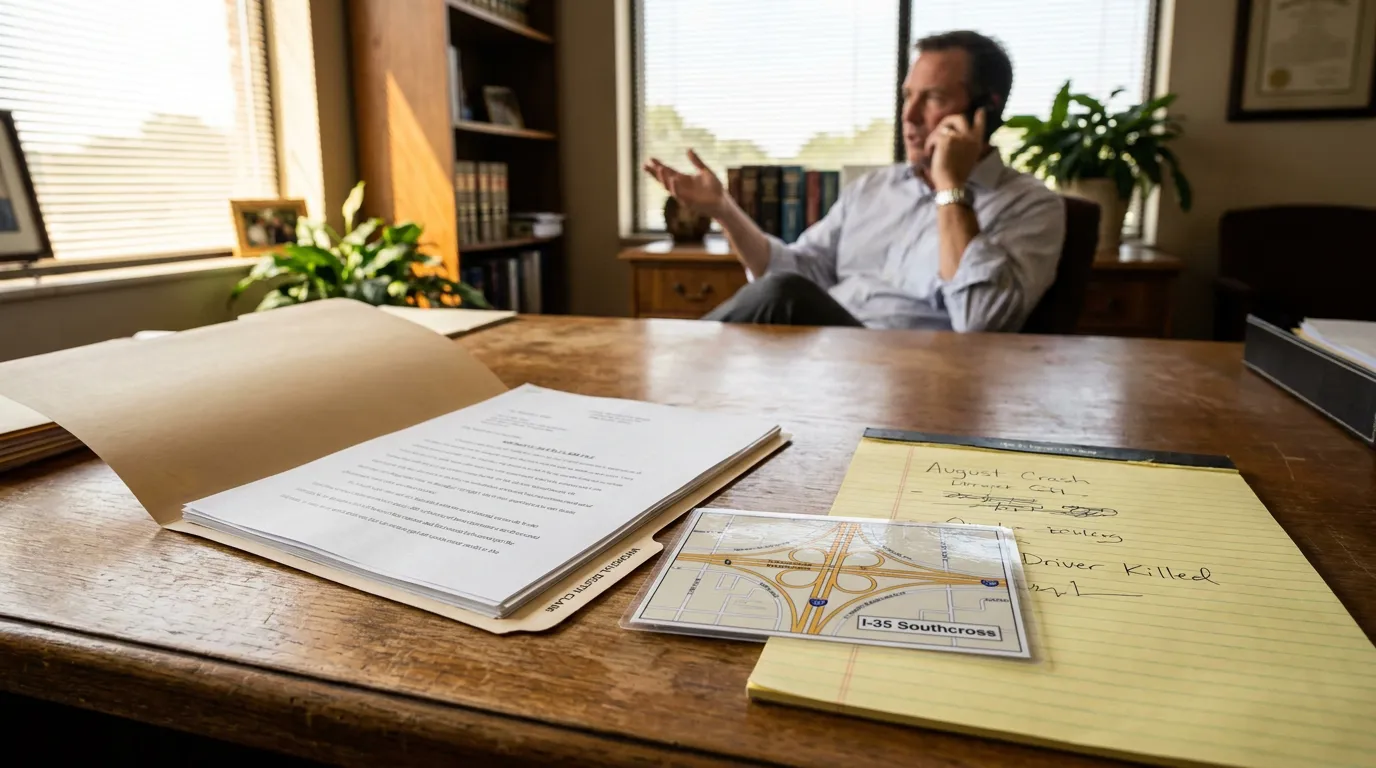
A recent fatal crash on Interstate 35 near Southcross in San Antonio has left another family facing unimaginable loss and a maze of legal questions. When a life is taken in a violent highway collision, grief is compounded by confusion over rights, deadlines, and accountability. For families across San Antonio and throughout Texas, understanding the legal framework is the first step toward reclaiming control. This is where the difference between a survival claim and a wrongful death claim becomes critical.
The Legal Framework Behind a Fatal San Antonio Traffic Death
Texas separates fatal crash claims into two distinct but related categories. The first is the survival claim, governed by the survival statute, which preserves the personal injury claim the deceased held at death, including conscious pain, suffering, and medical expenses. The second is the wrongful death claim, which belongs to certain surviving family members for their own losses. Chapter 71 of the Texas Civil Practice and Remedies Code houses both concepts and expressly applies to actions for personal injury or wrongful death.
Understanding who may bring these claims matters as much as understanding what they cover. A wrongful death action is a civil lawsuit brought by family members or dependents against an individual or entity liable for the death due to negligent, reckless, or intentional actions. Texas also recognizes derivative claimants, persons whose damages were caused by the wrongful death of another. This is why a spouse, children, or parents can pursue their own claims tied to the death, separate from the estate’s survival claim.
Modern law has widened the circle of people who may seek justice after a death. According to a respected legal encyclopedia published by Cornell Law School, modern wrongful death statutes have expanded these rules to allow a broader range of family members and dependents to file claims. That source explains that a wrongful death claim seeks to hold the responsible party accountable and secure compensation for survivors’ financial and emotional losses. For a plain-language overview of these rights, this explanation of a wrongful death action is a helpful starting point.
Why a Parked 18-Wheeler Collision Still Triggers Truck Accident Liability
One of the most misunderstood aspects of a parked 18-wheeler collision is the assumption that a stationary truck cannot create liability. Texas law forecloses that assumption. In the commercial vehicle context, the terms "operated," "operating," and "operation" mean to cause the vehicle to move or function in any respect, and that definition expressly includes stopping or parking the vehicle, as well as a commercial motor vehicle that has become disabled. A truck left in a dangerous position on or near I-35 can therefore fall squarely within the statute.
The stakes rise dramatically when the defendant is a motor carrier rather than an individual driver. Texas law provides a specific framework for holding an employer or motor carrier responsible for its driver’s negligence, and the statute governing commercial motor vehicle liability addresses civil actions seeking damages for death caused in an accident against a party that operated, owned, leased, or otherwise controlled the vehicle or its operator. For a surviving family, this can mean pursuing not only the driver but the company that employed and controlled the rig. Given the massive size disparity between a passenger car and a loaded tractor-trailer, these collisions frequently produce catastrophic, fatal outcomes that demand thorough investigation.
Any tortious injury that causes death may serve as the foundation for a claim. The Cornell source confirms that any tortious injury that caused someone’s death may be grounds for a wrongful death action. Negligent driving, unsafe parking, hours-of-service violations, and improper hazard warnings can all support a case, though every outcome depends on the specific facts and evidence preserved.
A Hypothetical San Antonio Family Facing the Unthinkable
Imagine a San Antonio mother driving home along I-35 near Southcross late one August evening in 2026. A tractor-trailer sits partially in the roadway, poorly lit and without adequate warning devices, and her vehicle strikes it at highway speed. She is hospitalized with catastrophic injuries and does not survive. Her husband and two children are left grieving, overwhelmed, and unsure whether they have a claim because the truck "was not moving."
This scenario reflects the reality many families confront, and the law offers meaningful avenues. Because parking a commercial vehicle counts as operating it, the trucking company’s conduct is squarely relevant. The estate may pursue a survival claim for the mother’s pre-death pain and medical bills, while the husband and children may pursue wrongful death claims for lost companionship, guidance, and financial support. Families in this position can learn more about what rights do families have after a fatal truck crash in San Antonio before making decisions.
Proving Negligence and Preserving the Evidence That Wins Cases
Winning a fatal truck crash case generally turns on three elements: a negligent or wrongful act, proximate causation of death, and compensable damages. Negligence proof rarely assembles itself, and critical evidence can disappear within days. Skid marks fade, electronic control module data is overwritten, and driver logs may be discarded absent a timely preservation demand. Acting quickly is often the difference between a provable case and a lost one.
Building that proof commonly involves coordinated work across several disciplines. In many cases, a strong plaintiff’s team relies on:
- Accident reconstruction professionals who analyze physical evidence and vehicle data
- Medical professionals who establish the cause and sequence of fatal injuries
- Economic analysts who quantify lost earnings, benefits, and household contributions
- Preservation letters that lock down black-box data, dashcam footage, and carrier records
- Witness statements gathered before memories fade
Paula Wyatt and Wyatt Law Firm approach these cases with the gravity and tenacity they demand. Recognized among top trucking trial lawyers and trusted by families in their darkest moments, the firm is built to stand against corporate defendants and insurance companies that fight aggressively to reduce or defeat legitimate claims. That said, no attorney can ethically guarantee a result, and every case is decided on its own facts.
The Filing Deadline Every Surviving Family Must Understand
Texas generally requires a wrongful death suit to be filed within two years, but the details matter. The controlling statute provides that a person must bring suit not later than two years after the day the cause of action accrues in an action for injury resulting in death, and the cause of action accrues on the death of the injured person. For a family whose loved one died in an August crash, the clock generally runs from the date of death rather than the collision date.
Exceptions exist, but Texas courts interpret them narrowly. The same statute sets a two-year deadline for personal injury and related claims, subject to enumerated exceptions. Tolling and discovery-rule arguments may apply only in limited circumstances, and separate rules may affect deadlines for minor beneficiaries; none are automatic or guaranteed. Because different deadlines and pre-suit notice requirements can apply to claims involving governmental entities, and because missing a deadline can permanently bar recovery, families should confirm their specific timeline early. To read a clear overview of these rights and definitions, consult a texas survival statute 71.021 lawyer resource before your time runs short.
How Does This Impact Me?
Does the Texas Survival Statute 71.021 Give Me a Separate Claim From Wrongful Death?
Yes, in most situations these are two distinct claims. The survival claim belongs to the deceased’s estate and covers what the deceased could have recovered had they lived, while wrongful death claims belong to eligible surviving relatives for their own losses. Both can often proceed together, though which applies depends on the facts.
Can I Still Sue if the 18-Wheeler Was Parked?
Very possibly, because Texas treats parking a commercial vehicle as operating it. A stationary truck that creates an unreasonable hazard can support a claim against the driver and motor carrier. Liability depends on proving negligence and causation with credible evidence.
How Long Do I Have to File After a Fatal I-35 Southcross Crash?
Generally two years from the date of death, but you should not wait. Evidence degrades quickly, and certain claims carry shorter or different deadlines. Confirming your deadline early protects your ability to pursue a surviving family claim.
What Should I Do First to Protect My Family’s Rights?
Prioritize preserving evidence and getting guidance before speaking with insurers. Avoid signing releases or giving recorded statements until you understand your rights. Early legal review can help secure black-box data and carrier records that adjusters have no incentive to protect.
Will My Case Settle or Go to Trial?
That depends on the facts, evidence strength, and the defendant’s willingness to be accountable. Some cases resolve through negotiation, while others require litigation to reach full and fair compensation. A firm prepared to try the case is often better positioned in either path.
Moving Forward With Clarity and Strength
A fatal collision on I-35 near Southcross reshapes a family’s life in an instant, but Texas law provides a framework for accountability. Understanding the difference between survival and wrongful death claims, recognizing that a parked truck can trigger liability, and respecting the two-year deadline are essential to protecting your rights. Outcomes always depend on the specific facts, and this article is general information rather than individualized legal advice. Grieving families deserve a powerful, compassionate advocate in their corner.
If your family is facing this heartbreak, you do not have to carry the legal burden alone. The team at Wyatt Law Firm brings extensive experience standing up to trucking companies and insurers on behalf of families who have lost everything. Call 210-340-5550 or contact us today to discuss how the law may apply to your situation.