
The Legal Tool That Stops a Trucking Company From Erasing Your Case
Key Takeaways: A spoliation letter is a formal written demand sent to a trucking company, its insurer, and anyone else holding evidence, asking them to preserve everything tied to the crash, from ELD and black box data to dash cam video, driver qualification files, maintenance records, and the truck itself. In a Midland-Odessa 18-wheeler case, it can help document that the carrier knew or should have known litigation was reasonably foreseeable, triggering Texas’s common-law duty to preserve evidence and any later spoliation remedy. Timing is critical: federal rules under 49 C.F.R. § 395.8(k)(1) require carriers to keep duty-status records for only six months, and third-party surveillance footage along I-20 can be overwritten within days. An effective letter itemizes each category of data, instructs the carrier to suspend automatic deletion, and requests the vehicle stay unrepaired for reconstruction. Texas law also broadly defines video evidence and, under Chapter 72, treats certain crash photographs and videos as presumptively admissible once authenticated, but only if the evidence still exists. The two-year limitations period and the evidence window are separate clocks, so families may need to act within days, not months.
A spoliation letter is a formal written demand, sent by an attorney to a trucking company, its insurer, and any other party holding evidence, asking them to preserve everything connected to the crash. In a Midland-Odessa 18-wheeler collision, that may mean ELD data, black box downloads, dash camera video, driver qualification files, maintenance and inspection records, drug and alcohol testing results, and the truck itself. The letter puts the carrier on notice that litigation may be coming, which can trigger a duty to stop routine deletion, overwriting, and repair. When a family is sitting in an ICU waiting room after a catastrophic collision on I-20 or Highway 191, this letter is often among the most important documents prepared in the first week of the case.
If your family is facing traumatic brain injury, spinal cord damage, amputation, or the death of someone you love after a commercial truck crash, the evidence clock may already be running. Wyatt Law Firm has spent decades confronting corporate carriers and their insurers, and Paula Wyatt, recognized among the nation’s Top 10 Trucking Trial Lawyers, moves fast to seek to lock down proof before it disappears. Call 210-340-5550 or contact us now for a confidential discussion of your case.
Why a Spoliation Letter Cannot Wait
In Texas, the duty to preserve evidence is primarily a common-law duty. Courts have held that a party must preserve evidence when it knows, or reasonably should know, there is a substantial chance a claim will be filed and that the evidence is material and relevant. The Texas Supreme Court’s decisions in Wal-Mart Stores, Inc. v. Johnson and Brookshire Brothers, Ltd. v. Aldridge set out that framework and the available remedies. Narrow statutory provisions exist elsewhere, for example, Tex. Civ. Prac. & Rem. Code § 138.004 requires a party with actual notice of allegations to treat relevant data as if already subject to a continuing production request. That provision applies only to food-consumption actions, but it illustrates the standard Texas law applies once a party is on notice.
The letter matters because notice can convert a general obligation into a documented one. A carrier can plausibly claim it did not know litigation was coming and that a hard drive simply cycled through its normal retention schedule. Once a written demand arrives, that argument becomes harder to sustain, and courts may weigh the timing and specificity of notice when deciding whether a loss of evidence was innocent, negligent, or intentional.
Remedies may be available when a party breaches its preservation obligations. Under Brookshire Brothers, a trial court finds spoliation after determining (1) a duty to preserve existed and (2) the party intentionally or negligently breached that duty. The court then assesses a proportionate remedy. The harsh remedy of a spoliation jury instruction requires intentional concealment or destruction, or, as a narrow exception, negligent conduct that irreparably deprived the other party of any meaningful ability to present a claim or defense. Lesser remedies may be imposed for ordinary negligent spoliation without meeting that heightened threshold. Courts also have discretion to impose sanctions under Texas Rule of Civil Procedure 215, and federal courts apply Federal Rule of Civil Procedure 37(e) to lost electronic data. The remedy imposed, if any, depends heavily on the facts, prejudice, and culpability shown. No outcome is guaranteed.
The Evidence That Vanishes First in a Permian Basin Truck Crash Claim
Electronic evidence in trucking cases can have a short and unforgiving shelf life. The Permian Basin runs on freight, with sand haulers, crude tankers, water trucks, and long-haul carriers sharing narrow two-lane roads with families. When a rig weighing up to eighty thousand pounds strikes a passenger vehicle, the forces involved can produce fatal or permanently disabling injuries. The data explaining why it happened may be the only neutral witness.
Evidence a well-drafted 18-wheeler evidence letter should demand generally includes:
- ELD hours-of-service records, including original and edited entries
- Engine control module and event data recorder downloads
- Forward-facing and driver-facing camera video
- Dispatch logs, bills of lading, weight tickets, and GPS pings
- Driver qualification file, training records, and prior violation history
- Maintenance, repair, and pre-trip/post-trip inspection reports
- Drug and alcohol testing documentation
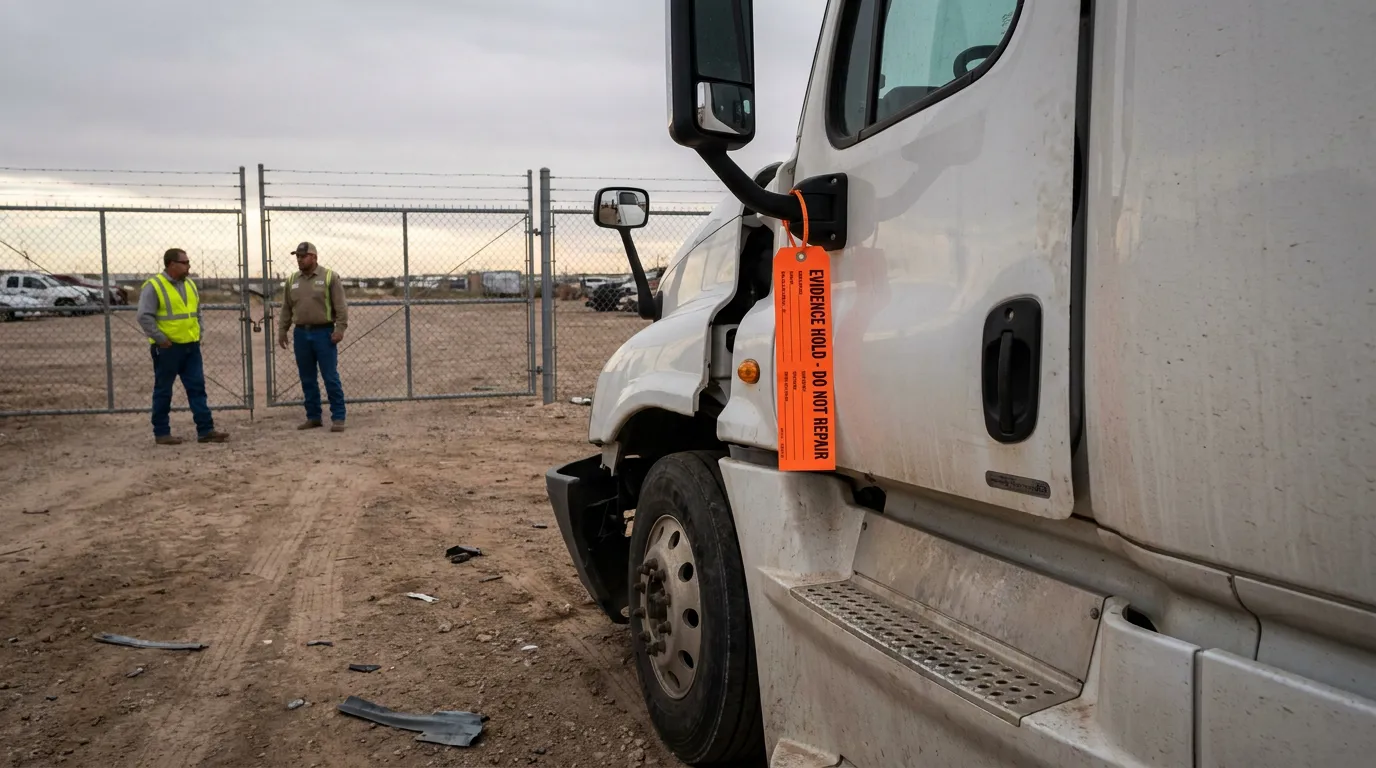
- The tractor, trailer, tires, and cargo in unaltered condition
Federal rules set only a minimum retention period. Under 49 C.F.R. § 395.8(k)(1), a motor carrier must retain duty-status records for not less than six months, and FMCSA guidance applies that same period to ELD records. After that window closes, data may lawfully be purged unless a legal hold or court order requires otherwise. Engine control module memory may be overwritten or lost far sooner, particularly if the truck is driven or repaired, one reason the demand generally needs to reach the carrier within days.
💡 Pro Tip: Photograph the truck, its DOT number, trailer markings, and any placards at the scene if you safely can. Fleet vehicles get repainted, re-lettered, and reassigned quickly across Permian Basin yards.
How ELD and Black Box Data Prove What Really Happened
Hours-of-Service Logs and Driver Fatigue
Electronic logging devices automatically capture driving time, engine hours, vehicle movement, and location data. FMCSA’s electronic logging device requirements under 49 C.F.R. Part 395 exist to record hours of service accurately, reducing the paper-log manipulation that plagued the industry for decades. Certain operations remain exempt, including some short-haul drivers and pre-2000 engine model year vehicles, so the first step is often confirming what system the truck used. In fatigue-driven catastrophic crashes, these records may help establish that a driver was behind the wheel past federal limits.
Original Versus Edited Entries
When a driver or carrier edits an ELD record, the original entry is generally not erased. Under 49 C.F.R. § 395.30, the system must retain the original record alongside any edited version, with changes preserved as annotations. Comparing original and edited logs may reveal attempted falsification, and a carrier’s failure to produce unedited data after a formal demand can itself support a spoliation argument.
Recording Devices and Access Restrictions
Texas restricts who may retrieve data from a vehicle’s onboard recording device. Under Tex. Transp. Code § 547.615, a recording device captures speed and direction, location, steering and brake performance, safety belt status, or transmits collision data. That information generally may not be retrieved by anyone other than the vehicle’s owner except by court order, consent, or limited exceptions. This statute addresses manufacturer-installed devices in passenger vehicles, while heavy-truck engine control module data is typically obtained through discovery and agreed download protocols. Because the carrier usually owns the tractor, an injured family may need counsel prepared to seek a court order quickly.
What a Properly Drafted Spoliation Notice Contains
A preservation demand is generally only as strong as its specificity. Generic language asking a company to "preserve all relevant evidence" can invite disputes about scope. An effective letter identifies each category of data by name, references governing federal and state authority, and states plainly that destruction may be presented to the court, while remaining reasonable in scope, since courts weigh proportionality.
| Element of the Letter | Why It Matters |
|---|---|
| Identification of the crash, date, location, and vehicles | Prevents claims of ambiguity about which incident is covered |
| Itemized list of documents and electronic data | Defeats arguments that a category was not reasonably identified |
| Instruction to suspend automatic deletion cycles | Addresses routine ELD and camera overwrite schedules |
| Demand to preserve the vehicle in unrepaired condition | Protects physical evidence for accident reconstruction |
| Request for inspection and joint download protocols | Avoids one-sided data retrieval by the defense |
| Citation to statutory preservation duties and sanctions | Documents notice for any later court motion |
Delivery and documentation can matter as much as content. Sending the notice to the carrier, registered agent, insurer, driver, and any lessor or maintenance vendor helps create a clear record. A letter alone does not compel compliance, formal relief generally requires a court order or a suit on file. Our discussion of whether a trucking company can destroy evidence walks through what may happen when a carrier ignores that record.
Video Evidence and the Texas Statutes Built for Truck Cases
Texas defines video evidence broadly enough to reach many cameras on a modern rig. Under Tex. Civ. Prac. & Rem. Code § 72.051(10), "video" means an electronic representation of a sequence of images, with or without accompanying audio, depicting either stationary or moving scenes, regardless of the manner in which the sequence of images is captured, recorded, or stored. The statute’s broad language may encompass dash cams, ELD-linked cameras, and forward-facing collision-avoidance footage, among other devices.
A dedicated statutory framework governs civil actions arising from commercial motor vehicle collisions. Chapter 72 defines a covered civil action as one seeking damages for bodily injury or death caused in a collision where a defendant operated, owned, leased, or controlled the vehicle or its operator. A court may not require expert testimony to admit a photograph or video except as necessary to authenticate it, and such evidence is presumed admissible. That presumption isn’t absolute, the evidence still must be authenticated and remains subject to the Texas Rules of Evidence, including Rule 403 objections. Chapter 72 also lets a defendant seek bifurcation on certain employer-liability and exemplary damages issues. Preservation is generally the precondition to ever reaching that presumption.
💡 Pro Tip: Third parties often hold footage the carrier does not control. Truck stops, refinery gates, oilfield yards, and roadside businesses along I-20 frequently overwrite surveillance video within days, so those requests should go out alongside the carrier demand.
Deadlines, Limitations, and the Cost of Waiting
Texas generally requires a personal injury or wrongful death lawsuit to be filed within two years of the injury or death. Parties may not agree to shorten that period; any such agreement is void. Certain circumstances may alter the deadline, legal disability, a defendant’s absence from the state, or a narrow discovery rule, but Texas courts interpret these exceptions narrowly.
The limitations period and the evidence window are generally two different clocks. A family may still have twenty months to file suit while the ELD data that could show fatigue has already been purged. Claims involving governmental entities can also carry separate administrative notice deadlines, often as short as six months under the Texas Tort Claims Act and shorter under some city charters. This is why an experienced Midland-Odessa truck accident attorney often treats the preservation demand as an emergency, not a formality.
Frequently Asked Questions
1. How quickly should a spoliation letter go out after a crash?
As soon as possible, ideally within days. Camera systems and telematics platforms often overwrite on short cycles, and a legal hold generally requires written notice before that cycle completes. Waiting weeks can mean the loss of data that may not be recoverable.
2. Can I send a preservation letter myself?
Nothing prohibits an injured person from sending written notice. However, effectiveness may depend on precise identification of federal recordkeeping categories, statutory citations, and technical data types. Carriers and their defense counsel may respond differently to a letter that shows the sender knows exactly what exists.
3. What happens if the trucking company destroys the evidence anyway?
A court may impose a remedy where a preservation duty was breached and the required showing is made. Under Texas law, a spoliation jury instruction generally requires intentional spoliation, or negligent spoliation that irreparably deprived the other party of any meaningful ability to present a claim or defense; lesser remedies such as discovery sanctions or exclusion of evidence may apply for ordinary negligent spoliation without meeting that heightened threshold. Outcomes are fact-dependent, and courts scrutinize these requests carefully.
4. Does a spoliation letter start a lawsuit?
No. It is a pre-suit notice, not a pleading. The letter seeks to preserve proof while an Odessa truck accident lawyer investigates liability, damages, and every potentially responsible party. Filing may follow, and Texas does not recognize an independent cause of action for spoliation, so the remedy comes within the underlying case.
5. Who besides the motor carrier should receive the demand?
Anyone who may hold or control relevant evidence, commonly including the driver, insurer, trailer lessor, shipper, maintenance vendor, and any telematics provider hosting the data offsite.
Protecting the Proof That Protects Your Family
A spoliation letter will not undo a catastrophic injury or bring back someone who died on a Permian Basin highway. What it may do is help preserve the truth. Texas preservation duties, federal recordkeeping minimums, and statutory presumptions favoring photographic and video evidence can work together, but generally only if the data still exists when the case reaches a courtroom. Every outcome depends on the specific facts, and the earliest days after a crash may carry consequences that cannot be reversed later.
Do not let a corporate carrier control the record of what happened to your family. Reach out to Wyatt Law Firm today, call 210-340-5550, or request your free consultation so Paula Wyatt and her team can begin working to secure evidence immediately.
Disclaimer: This content is for informational purposes only and is not legal advice. Every case is unique, and results may vary. Consult an attorney about your specific circumstances.