
The Hidden Danger of Carbon Monoxide Poisoning From Keyless Ignition Cars in Texas
Key Takeaways: Keyless ignition vehicles pose a fatal carbon monoxide poisoning risk when left running in attached garages. Federal regulators identified this danger over a decade ago but delayed action while deaths mounted. Texas product liability law allows victims and families to hold manufacturers accountable for design defects, including failure to incorporate automatic engine shut-off technology. A two-year statute of limitations applies, making prompt legal action critical.
Yes, a keyless ignition car can cause fatal carbon monoxide (CO) poisoning. A driver exits a push-button start vehicle without realizing the engine is still running, and the car idles for hours inside an attached garage. Carbon monoxide, an odorless and colorless gas, silently fills the home, causing catastrophic brain damage or death. As of 2018, at least 28 deaths and 45 injuries had been attributed to CO poisoning from keyless ignition vehicles, with the true toll believed significantly higher.
If your family has been affected by a carbon monoxide poisoning car tragedy, Wyatt Law Firm is ready to fight for you. Call 210-340-5550 or reach out to our team today for a free consultation.
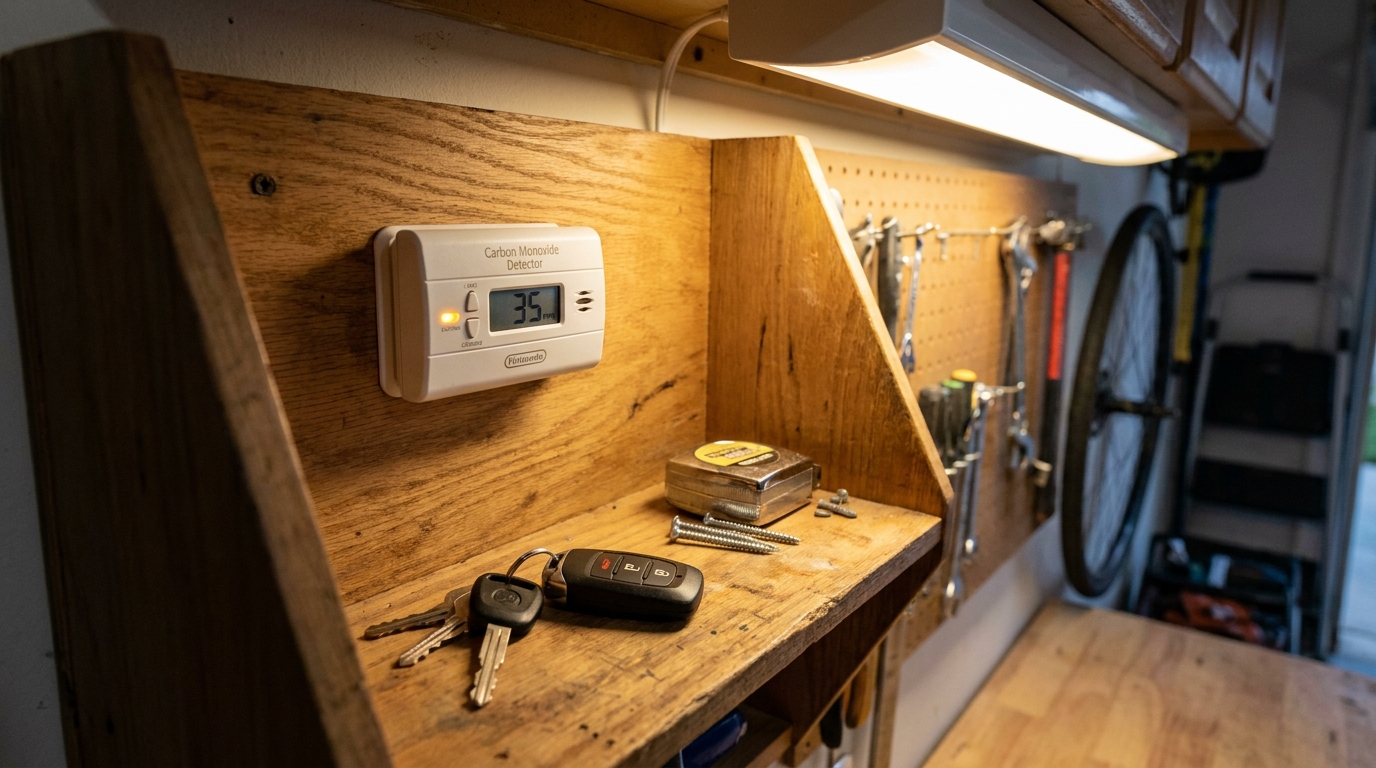
How Keyless Ignition Vehicles Create a Carbon Monoxide Death Trap
Traditional key-operated ignitions provided built-in safety cues that keyless systems eliminated. Removing a physical key gave drivers tactile and visual confirmation that the engine was off. NHTSA’s proposed rulemaking acknowledged that the lack of these cues created conditions for real-world CO poisoning incidents. Today, more than half of the 17 million new vehicles sold annually in the United States use keyless ignition, meaning the risk grows yearly.
The scenario typically unfolds the same way. A driver pulls into an attached garage, grabs the key fob, and walks inside, assuming the engine has stopped. Because the fob only needs to be near the vehicle to start it, many drivers never press the stop button. The engine continues running. Carbon monoxide accumulates in the garage and seeps into living spaces through shared walls, doors, and ductwork. Victims are often asleep when exposure reaches fatal levels.
💡 Pro Tip: Always verify the engine is off before leaving your keyless ignition vehicle. Look at the dashboard or listen for the engine. Install a CO detector in your garage and adjacent rooms.
Why Carbon Monoxide Is So Deadly
Carbon monoxide binds to hemoglobin roughly 200 to 250 times more effectively than oxygen, rapidly starving the brain and organs. Victims may experience headache, dizziness, and nausea. At higher concentrations, CO poisoning causes seizures, permanent neurological damage, cardiac injury, and death. The gas is impossible to detect without a CO alarm.
NHTSA Knew the Risk and Failed to Act
Federal regulators identified keyless ignition vehicles as a clear safety hazard more than a decade before taking meaningful action. In 2011, NHTSA proposed a rule requiring audible warnings when a driver exits a keyless vehicle with the engine running, but declined to mandate auto-shutoff technology. The comment period for that proposed rule closed in March 2012, and NHTSA took no final action for over a decade.
During that regulatory gap, people continued to die. The Infrastructure Investment and Jobs Act of 2021 finally compelled the agency to require automatic engine shut-down features. For families who lost loved ones during those years of delay, the question of manufacturer accountability becomes critical.
💡 Pro Tip: Regulatory inaction does not shield manufacturers from civil liability. Even without federal regulation mandating a specific safety feature, Texas product liability law allows victims to argue that a safer alternative design existed and should have been used.
Texas Product Liability Law and Carbon Monoxide Poisoning Car Claims
Texas law provides a clear framework for holding car manufacturers accountable when a defective product causes death or catastrophic injury. Under Tex. Civ. Prac. & Rem. Code § 82.001(2), a "products liability action" encompasses claims against a manufacturer or seller for damages arising from personal injury, death, or property damage caused by a defective product, including design defect theories applicable to keyless ignition CO poisoning cases.
For design defect claims involving the absence of an auto-shutoff feature, Texas law imposes specific requirements. Under Tex. Civ. Prac. & Rem. Code § 82.005(a), a claimant must prove by a preponderance of the evidence that (1) a safer alternative design existed, and (2) the design defect was a producing cause of the injury or death. Section 82.005(b) requires that the safer alternative design would have prevented or significantly reduced the risk without substantially impairing the product’s utility, and that it was economically and technologically feasible. For keyless ignition vehicles, this argument is compelling: auto-shutoff technology is available, effective, and already used by some manufacturers.
Who Can Be Held Liable
Car manufacturers can be held liable under Texas law as both designers and sellers who placed a defective product into commerce. Tex. Civ. Prac. & Rem. Code § 82.001(4) defines a "manufacturer" broadly to include any person who is a designer, formulator, constructor, rebuilder, fabricator, producer, compounder, processor, or assembler of any product or any component part thereof and who places the product or any component part thereof in the stream of commerce.
The following table outlines key legal theories available in Texas keyless ignition CO poisoning cases:
| Legal Theory | What Must Be Proven | Applicable Statute |
|---|---|---|
| Design Defect | Safer alternative design existed and was economically and technologically feasible; defect was producing cause of injury | Tex. Civ. Prac. & Rem. Code § 82.005(a), (b) |
| Strict Liability | Product was defective and unreasonably dangerous; defect caused harm | Tex. Civ. Prac. & Rem. Code § 82.001 et seq. |
| Negligence | Manufacturer failed to exercise reasonable care in design or warnings | Common law negligence principles |
| Wrongful Death | Death resulted from defendant’s wrongful act, neglect, or default | Tex. Civ. Prac. & Rem. Code § 71.002 |
💡 Pro Tip: Preserve all evidence immediately after a CO poisoning incident. This includes the vehicle, key fob, garage dimensions, CO detector readings, medical records, and autopsy reports. Evidence can disappear quickly.
The Two-Year Deadline You Cannot Afford to Miss
Texas imposes a two-year statute of limitations on personal injury and wrongful death claims. This means families typically have two years from the date of death or injury to file a lawsuit. Texas also imposes a 15-year statute of repose on products liability claims under Tex. Civ. Prac. & Rem. Code § 16.012, which may bar claims involving older vehicles.
💡 Pro Tip: Do not wait until you feel "ready" to explore your legal options. The statute of limitations clock starts running from the date of injury or death, and critical evidence may deteriorate over time.
What to Do After a Carbon Monoxide Poisoning Car Incident in Texas
If you suspect carbon monoxide exposure from a vehicle, your first priority is medical attention. CO poisoning requires immediate treatment, often including hyperbaric oxygen therapy for severe cases. Every moment of delay can worsen brain injury and organ damage.
Steps to protect your health and legal claim include:
- Seek emergency medical treatment and request a carboxyhemoglobin blood test
- Call 911 and request a fire department CO reading of your home and garage
- Do not move or alter the vehicle until it has been documented and photographed
- Obtain and preserve all medical records, imaging studies, and treatment notes
- Contact a carbon monoxide poisoning attorney who handles vehicle CO cases in Texas
Texas Transportation Code § 601.072 requires motor vehicle liability insurance to provide minimum coverage of $30,000 for bodily injury or death of one person. While insurance may provide initial recovery, these minimums are insufficient for catastrophic CO poisoning or wrongful death cases. A product liability claim against the vehicle manufacturer offers full compensation, including medical costs, lost earnings, pain and suffering, and wrongful death damages. Texas’s proportionate responsibility rules under Tex. Civ. Prac. & Rem. Code § 33.001 et seq. may reduce or bar recovery if a claimant is found to bear more than 50 percent responsibility for the harm.
The Scope of This Crisis Is Not Slowing Down
Carbon monoxide deaths from keyless ignition vehicles represent a preventable tragedy that automakers have known about for years. Despite this knowledge, manufacturers continued selling millions of vehicles without automatic shut-off features, prioritizing convenience and cost savings over human life.
For families in Texas, the legal tools to fight back are available, but the window to act is limited. Understanding how exhaust system dangers contribute to vehicle CO exposure is important for building a strong claim.
💡 Pro Tip: If a loved one died from CO poisoning and the vehicle had a keyless ignition system, request that law enforcement and the medical examiner document the vehicle’s engine status, the presence or absence of CO detectors, and the garage layout relative to living spaces.
Frequently Asked Questions
1. Can I sue a car manufacturer for carbon monoxide poisoning from a keyless ignition vehicle in Texas?
Yes. Texas product liability law under Tex. Civ. Prac. & Rem. Code § 82.001 allows victims and families to bring claims against manufacturers when a defective product causes death or serious injury. Claims may proceed under design defect, strict liability, or negligence theories, with design defect claims requiring proof of a safer alternative design under § 82.005.
2. How long do I have to file a CO poisoning lawsuit in Texas?
Texas generally imposes a two-year statute of limitations for personal injury and wrongful death claims. A 15-year statute of repose may also apply to products liability actions. Consult with an attorney immediately to avoid losing your right to compensation.
3. What damages can families recover in a wrongful death case involving vehicle CO poisoning?
Families may seek compensation for medical expenses before death, funeral and burial costs, loss of future earnings, loss of companionship and guidance, and mental anguish. Specific damages depend on the circumstances and the claimant’s relationship to the deceased.
4. Does NHTSA’s failure to regulate keyless ignition affect my lawsuit?
Not necessarily. The absence of federal regulation does not prevent a civil product liability claim in Texas. Under Tex. Civ. Prac. & Rem. Code § 82.005(a), a claimant can prove that a safer alternative design existed, regardless of whether regulators mandated that design. NHTSA’s findings documenting the known danger may strengthen a plaintiff’s case.
5. What if the vehicle owner did not have a CO detector in the garage?
While CO detectors are important, their absence does not automatically excuse a manufacturer from liability for defective design. The core question is whether the manufacturer should have designed the vehicle with adequate safeguards to prevent foreseeable CO poisoning risk. However, a manufacturer may argue comparative fault, and under Texas proportionate responsibility rules, a jury could allocate fault to the vehicle owner, potentially reducing or barring recovery.
Your Family Deserves a Relentless Advocate
Carbon monoxide poisoning from a keyless ignition car is not an accident. It is the foreseeable consequence of a design choice that automakers made and that regulators failed to correct for over a decade. If your family has been devastated by a car carbon monoxide death in Texas, you have legal options, but the clock is ticking.
Paula Wyatt and the team at Wyatt Law Firm have the tenacity and proven track record to take on major manufacturers and fight for the full compensation your family deserves. Call 210-340-5550 or contact us now for a free, confidential consultation.