
What a Bexar County Intersection Death Could Mean for an 18 wheeler accident attorney San Antonio Case
Key Takeaways: A fatal Bexar County 18-wheeler crash at an intersection raises questions about right-of-way, speed, driver conduct, and trucking company responsibility. Texas law gives families two civil paths: wrongful death claims and survival claims. Critical evidence includes inspection records, maintenance files, driver qualification documents, electronic data, and intersection evidence. Liability may extend beyond the driver to the carrier, owner, or other entities.
A fatal intersection collision involving an 18-wheeler can change a family’s life in seconds. For families in San Antonio and across Bexar County, legal questions begin immediately: who had the right-of-way, whether the truck was moving too fast, whether the carrier followed safety rules, and what remedies Texas law allows. When a Bexar County 18-wheeler crash happens at a controlled intersection, answers often depend on evidence that can disappear quickly unless preserved.
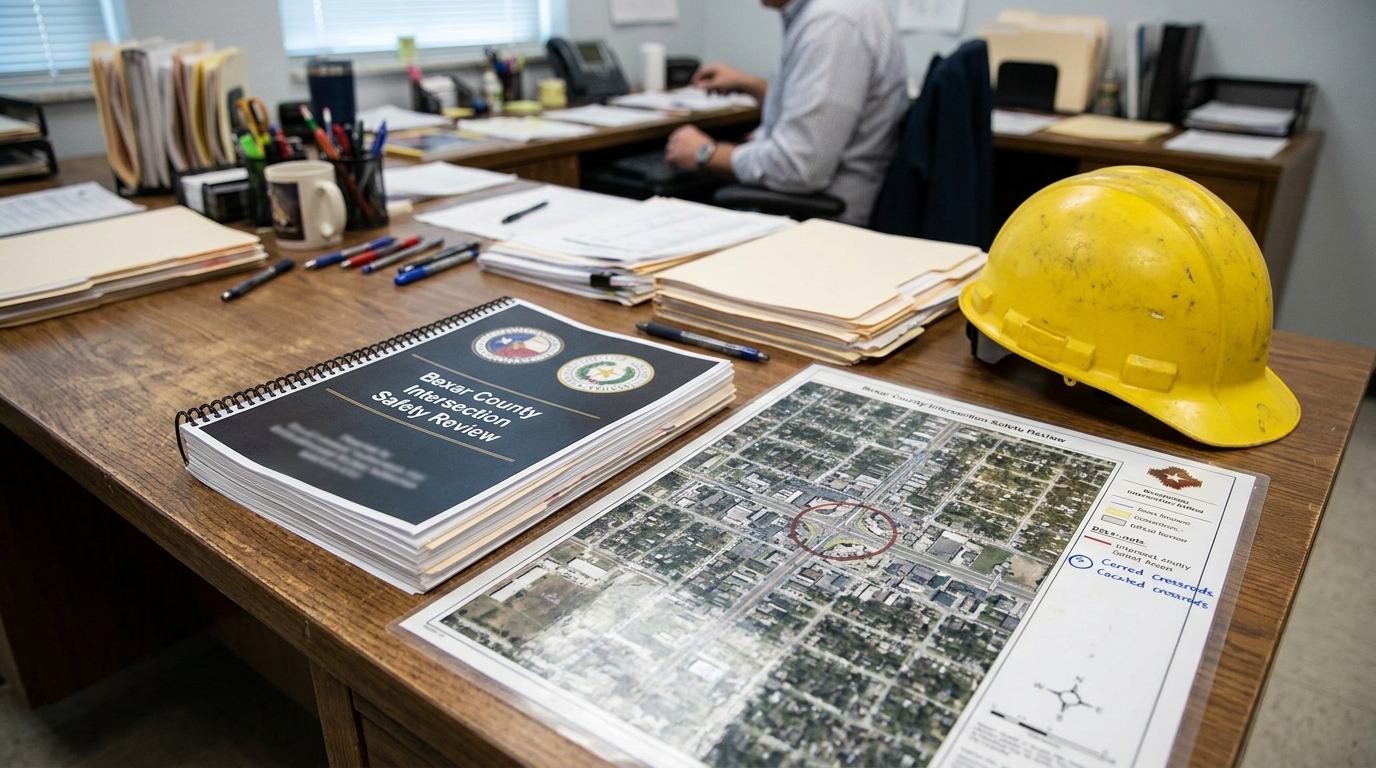
Why Intersection Truck Crashes Demand Close Legal Scrutiny
Intersection wrecks involving commercial trucks often present more than a simple two-vehicle negligence dispute. Texas law requires drivers to stop, yield, and give right-of-way under specific intersection rules. In a fatal intersection truck collision Texas case, this becomes central to fault analysis.
The size and operating limits of a tractor-trailer also matter. Texas law treats large commercial vehicles differently, including inspection requirements and the broader regulatory framework that applies when bodily injury or death is caused by a commercial motor vehicle. A tractor-trailer on public highways may qualify as a commercial motor vehicle, affecting what safety rules apply and broadening the range of potentially responsible parties.
Speed can also become central near urban intersections. Texas sets prima facie speed rules under Transportation Code Section 545.352. In an urban district, 30 miles per hour is the lawful prima facie speed; any speed in excess of 30 mph is prima facie evidence that the speed is not reasonable and prudent and is unlawful. Under Section 545.351(c), a driver is required to drive at an appropriate reduced speed when a special hazard exists with regard to traffic, pedestrians, or weather or highway conditions, a duty that operates consistently with, and goes beyond, the general reasonable-and-prudent speed standard in Section 545.351(b). The statute does not prescribe a specific mph threshold; the appropriate reduced speed depends on the circumstances. A truck’s speed entering an intersection may affect stopping distance, impact force, and whether the collision was avoidable.
The Texas Framework Families May Rely On After a Fatal Truck Crash
Texas families typically confront two separate civil claims after a deadly crash. Wrongful death claims focus on losses suffered by certain surviving family members, while survival claims concern the decedent’s own claim that survives in favor of the estate. These claims are often filed together but are not interchangeable, and damages are calculated differently in each.
The governing wrongful death statute is found in Chapter 71 of the Texas Civil Practice and Remedies Code. That framework is the starting point for families evaluating a truck accident wrongful death claim Texas. The Texas Legislature’s wrongful death chapter sets out the governing provisions.
Who may bring a claim can be critically important. A surviving spouse, child, or parent may pursue wrongful death damages for their own losses. Texas also recognizes that an informal spouse may qualify if the marriage can be proven under Texas law, though this requires substantial evidence.
Wrongful Death and Survival Are Not the Same
These two claims serve different purposes. A wrongful death claim addresses losses suffered by statutory beneficiaries because of the death itself. A survival claim allows the estate to pursue the claim the decedent could have brought had the person lived.
That distinction matters when evaluating damages. Monetary damages are the primary civil remedy, but there is no automatic recovery. Families may find it helpful to review this discussion of families’ rights after a fatal truck crash in San Antonio.
Exemplary Damages May Be Available in Severe Cases
Texas law can permit more than actual damages under limited circumstances. If a death results from a willful act, omission, or gross negligence, exemplary damages may be recoverable under Section 71.009. In a catastrophic commercial trucking case, those allegations may arise when facts suggest extreme risk and conscious indifference.
A San Antonio Family’s Worst Day: A Realistic Hypothetical
Imagine a family learns that a loved one was killed when an 18-wheeler entered a Bexar County intersection and struck the driver’s side of a smaller vehicle. Within hours, the carrier’s insurer begins assessing exposure while the family is still trying to understand what happened. They do not yet know whether the truck driver failed to yield, whether the vehicle had maintenance issues, or whether the company had prior warning signs in its records.
In that moment, the legal and practical pressures can feel overwhelming. Funeral expenses, sudden loss of household income, and emotional trauma may collide with aggressive insurance tactics and incomplete information. In many fatal truck accident San Antonio cases, the earliest days are when evidence preservation becomes most important because electronic data, driver logs, onboard systems, dispatch communications, and post-crash vehicle conditions may shape the entire case.
What Evidence May Matter Most
The strongest truck crash cases are often built on records the public never sees. Police reports matter, but they are rarely the full story. A serious case may also turn on:
- Electronic logging and onboard data
- Driver qualification and training files
- Inspection and maintenance records
- Weight records and cargo information
- Intersection video or nearby surveillance footage
- Cell phone, dispatch, and route communications
- Post-collision vehicle inspection results
Texas law reinforces why inspection records matter. Commercial motor vehicles registered in Texas generally must pass annual inspections tied to safety requirements that can incorporate applicable federal motor carrier safety standards. The state’s commercial vehicle inspection law provides the framework.
When the Trucking Company May Also Face Liability
A fatal commercial truck crash may involve more than just the driver’s negligence. Under Texas law, a company may be liable on a respondeat superior theory when the driver was an employee acting within the course and scope of employment. Separate claims for the company’s own negligence may also be available.
That distinction matters because companies often control the evidence. The carrier may possess maintenance schedules, hiring records, supervision files, telematics data, prior safety warnings, and internal communications that a family cannot access on its own. In a serious commercial truck accident in San Antonio, those records may show whether the collision resulted from a single driving error or a larger safety breakdown.
The Statutory Reach Is Broad
Texas law can allow claims against more than just the driver. If bodily injury or death was caused in a collision involving a commercial motor vehicle, liability theories may extend to other persons or entities, such as an employer, owner, lessor, maintenance provider, or other party whose conduct or legal relationship supports liability. This can be important in a wrongful death truck crash Bexar County case involving layers of ownership, leased equipment, or contracted operations.
Financial Responsibility Can Become an Early Issue
Insurance and financial responsibility may come into focus soon after a serious wreck. Questions about available coverage, policy limits, self-insurance, and other sources of recovery can arise early. For grieving families, adequate coverage becomes critical after a catastrophic collision.
Why Intersection Safety Questions Often Point to Preventable Harm
Many fatal truck crashes at intersections raise the possibility that the death was preventable. A failure to yield, excessive speed, poor lookout, distraction, fatigue, mechanical failure, or inadequate braking distance can all contribute to a violent impact. In San Antonio, where urban growth increases traffic density, these issues become especially dangerous when a fully loaded tractor-trailer enters the equation.
The legal question is whether the death was caused by legally recognized wrongful conduct. Where evidence shows negligence, gross negligence, or operational failures by a carrier, Texas law may provide a path for accountability.
What Families Should Understand in the First Days After a Talley Road Truck Accident or Similar Crash
The first week after a deadly truck wreck is often when the gap between a family and a trucking company becomes most obvious. The carrier may already have investigators, adjusters, and legal counsel evaluating the case while loved ones are trying to obtain basic answers. That imbalance is one reason families often seek a trial-ready advocate with extensive experience handling catastrophic collisions.
Practical steps can matter immediately, even before any lawsuit is filed. Families may benefit from preserving key documents, photos, witness names, and communications. They may also need guidance on how wrongful death and survival claims differ, who may file, and how to avoid early mistakes while a Talley Road truck accident or similar fatal collision is being investigated.
For broader information about pursuing serious commercial vehicle claims, readers can review Wyatt Law Firm’s page for an 18 wheeler accident attorney San Antonio lawyer. That kind of case often demands immediate attention to liability, causation, damages, and preservation of proof.
How Does This Impact Me?
If the truck driver failed to yield, does that help my family’s case?
It may. Evidence that a truck driver failed to stop or yield as required can strongly support a negligence claim. That does not end the case, because facts still matter and comparative responsibility may be disputed, but it can be significant in proving fault.
Can my family bring a claim if the person who died was not formally married but lived as a spouse?
Possibly. Texas recognizes informal marriage, but proving it can be fact-intensive, and the person asserting that status carries the burden of presenting sufficient evidence.
Are the truck driver and trucking company both potentially responsible?
In many cases, yes. The driver may be directly liable for negligent driving, and the company may also face liability if the driver was acting within the scope of employment. Separate claims for the company’s own negligence may also be available depending on the facts.
Does this change the deadline to file a case?
This article does not determine any specific deadline for your situation. Filing deadlines can depend on the type of claim, the parties involved, and whether any unusual tolling argument is raised. Claims involving governmental defendants can involve different notice requirements and deadlines.
What should families do after a catastrophic truck injury San Antonio crash or fatal wreck?
They should focus first on safety, medical needs, and preserving information. It is important to secure crash reports, photographs, witness information, and any notices from insurers. Because evidence in commercial trucking cases can be highly technical and time-sensitive, early legal guidance may be important.
When Accountability Matters Most
A fatal truck collision at a Bexar County intersection is not just a news event. It is often the beginning of a complex legal fight over fault, corporate responsibility, and the full human cost of a violent death. For families in San Antonio facing that reality, Texas law may provide meaningful avenues for recovery, but those claims are often fact-sensitive and demand careful attention to right-of-way rules, inspection compliance, company records, and the distinction between wrongful death and survival damages.
N/A:
- Are all legal claims and statutes legally accurate and nuanced?
- Do all legal claims address exceptions or limitations when applicable?
- Do any legal claims or facts contradict one another?
- Are any legal claims or facts partially correct?
- Could any legal claims or facts be clearer and more concise?