
The Gap That Exposes a Trucking Company’s Negligence
When a fully loaded 18-wheeler barrels through the Permian Basin and slams into a passenger vehicle, the difference between life and death often comes down to whether the trucking company ever should have put that driver behind the wheel. The federal government requires every motor carrier to keep a detailed record proving each driver was screened and qualified. That record is the 49 cfr 391.51 driver qualification file lawyer teams fight to obtain, because when that file is missing or incomplete after a catastrophic Midland truck accident, the gap itself becomes powerful evidence that the carrier hired an unqualified, dangerous driver.
If a truck crash in Midland-Odessa took someone you love or left them with a traumatic brain injury, spinal cord damage, or permanent disability, you deserve answers now. Call Wyatt Law Firm at 210-340-5550 or reach our team through our contact page for a FREE CONSULTATION. With more than $1 BILLION recovered for injured Texans and NO RECOVERY FEE, we are your voice against the corporations and insurers who want that missing file to stay buried.
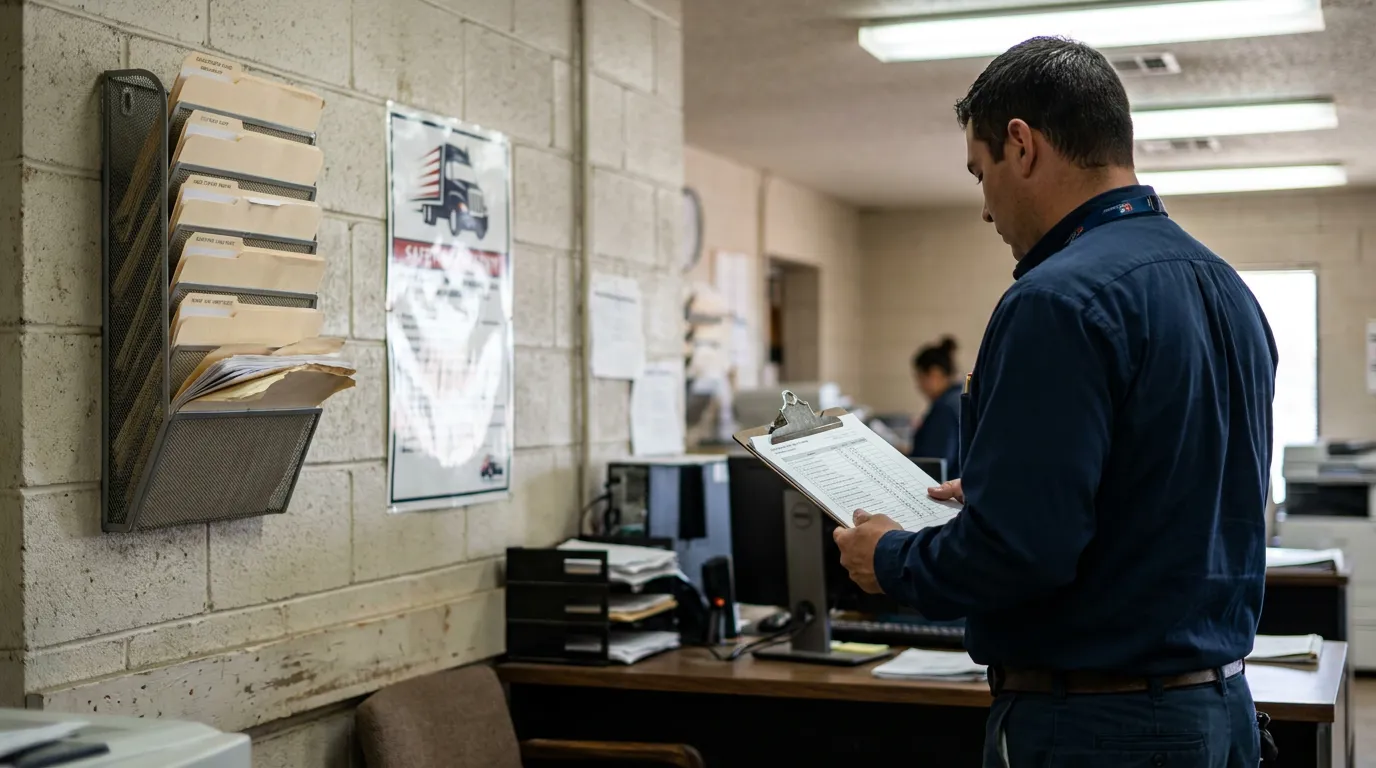
What the 49 CFR 391.51 Driver Qualification File Must Contain
A driver qualification file (DQ file) is the set of records that 49 CFR 391.51 requires every motor carrier to keep for each commercial driver. This includes the employment application, motor vehicle records, previous-employer safety history, road-test certificate, and medical examiner’s certificate. A missing or incomplete file can be evidence that the trucking company failed to properly screen an unqualified driver.
The rule exists because a commercial driver operating an 80,000-pound rig carries a duty that ordinary motorists do not. Under 49 CFR 391.51, a complete DQ file must contain:
- The driver’s employment application and prior work history
- Motor vehicle record (MVR) obtained at hiring and updated annually
- Previous-employer safety and drug-and-alcohol history
- Road-test certificate or equivalent showing driving skill
- Medical examiner’s certificate confirming physical fitness
Federal regulators expect these files to be available fast. Under FMCSA enforcement of § 391.51, a carrier that cannot produce a complete driver qualification file within two business days is generally treated as being in violation. When a company suddenly cannot locate a missing DQ file after a fatal wreck, that silence speaks loudly.
Why a Missing or Incomplete DQ File Points to Negligent Hiring
A missing driver qualification file does not just show sloppy paperwork. It can show the carrier never confirmed the driver was safe to operate a commercial truck. Texas recognizes that negligent hiring is an exception to the general rule that a person has no duty to protect others from a third party’s conduct, as explained in Doe v. Boys Clubs of Greater Dallas, 868 S.W.2d 942, 950 (Tex. 1994). This means a trucking company can owe an affirmative duty to the driving public when it puts an unfit driver on the road.
Texas law treats an employer’s knowledge as "constructive" when the danger could have been discovered through reasonable investigation. If a background check, MVR review, or Drug and Alcohol Clearinghouse query would have revealed a disqualifying record, the carrier is generally charged with knowing it, whether or not it actually looked. A missing file cannot shield the company, because the omitted records are treated as knowledge it should have had. This is why preserving truck accident evidence early is critical to proving trucking negligence.
The duty runs to the public, not just to co-workers. Texas courts have held that a master’s duty regarding an incompetent servant is owed to the public as well as to other employees, as stated in Arrington’s Estate v. Fields, 578 S.W.2d 173, 178 (Tex. Civ. App., Tyler 1979).
💡 Pro Tip: The absence of a required document is often as important as its contents. Preserve any crash report, carrier name, and truck number immediately, because those details help your legal team demand the DQ file before it can be altered or lost.
How Texas Law Lets You Hold the Carrier, Not Just the Driver, Accountable
Texas gives you a path to pursue the trucking company itself, not only the individual driver. An employer is liable for negligent hiring, supervision, or retention when it hired an employee it "knew or, by the exercise of reasonable care, should have known was incompetent or unfit," as the court held in Dangerfield v. Ormsby, 264 S.W.3d 904, 912 (Tex. App., Fort Worth 2008). A missing DQ file is direct evidence that required screening never happened.
Carrier liability in these cases is not automatic. You generally must show that the carrier’s failure to investigate or screen proximately caused the injuries. Texas also has a dedicated framework for holding a motor carrier responsible under Tex. Civ. Prac. & Rem. Code § 72.054. You can review the state-law framework in Texas Civil Practice and Remedies Code Chapter 72, which pairs with the federal rules to reach the company behind the driver.
One caution matters here. Negligent hiring claims can sometimes be challenged early under the Texas Citizens Participation Act (TCPA), which allows employers to seek dismissal and can suspend discovery, as seen in Walgreens v. McKenzie, No. 23-0955 (Tex. May 16, 2025). This is one more reason experienced trial counsel matters.
The Two-Phase Trial and Exemplary Damages
Under Tex. Civ. Prac. & Rem. Code § 72.052, a defendant in a commercial motor vehicle collision case can require the trial to be split into two phases. Phase one decides liability and compensatory damages, and phase two addresses exemplary (punitive) damages. This statute was added by H.B. 19 in 2021 and amended by H.B. 2190 in 2023.
This structure helps catastrophic-injury victims when handled by a trial-ready advocate. Section 72.052(e) allows a first-phase finding that the driver was negligent to serve as the basis for proceeding against the employer in phase two on claims such as negligent entrustment. A missing DQ file is often exactly the kind of proof used to reach the carrier’s hiring conduct and support exemplary damages. Paula Wyatt, recognized as a Top 10 Trucking Trial Lawyer with decades fighting corporate defendants and insurers, built her practice on this Chapter 72 fluency.
Why the Permian Basin Makes Unqualified-Driver Crashes So Deadly
Midland-Odessa sits at the heart of the Permian Basin, where oilfield demand puts thousands of heavy commercial trucks on two-lane roads and crowded highways every day. A loaded tanker or sand hauler can weigh 20 to 40 times more than a family car, so a West Texas truck crash routinely produces traumatic brain injuries, spinal cord damage, amputations, severe burns, and wrongful death.
Oilfield production pressure pushes some carriers to cut corners on hiring. When a company rushes an unqualified or fatigued driver into a rig to meet a quota, the consequences are often fatal. That reality makes the missing DQ file even more damning.
How We Secure the DQ File Before It Disappears
The single biggest risk to your case is that the evidence proving negligent hiring can vanish. Trucking companies control the DQ file, and you generally will not see it until litigation begins. That is why prompt legal action to send spoliation and preservation letters matters, warning the carrier that destroying records carries serious consequences.
Evidence windows in trucking cases can be short, and some records are subject to strict FMCSA retention windows — ELD and hours-of-service data must be kept for at least six months under 49 CFR 395.8(k), maintenance logs must be retained for 1 year while the vehicle is in service plus 6 months after the motor vehicle leaves the motor carrier’s control under 49 CFR Part 396, Section 396.3(c), and annual inspection reports require a 14-month retention period under 49 CFR 396.17 — making prompt preservation demands critical, as carriers may legally destroy these records once the applicable minimum retention period expires, though doing so during active litigation can expose them to spoliation sanctions. Our team moves quickly to demand the driver qualification file, ELD data, and maintenance logs before anything is lost. To understand the stakes, read our guide on what happens when a trucking company destroys evidence after a serious crash.
Deadlines: The Two-Year Texas Statute of Limitations
In most Midland truck accident cases, you generally have two years to file suit. Tex. Civ. Prac. & Rem. Code § 16.003(a) requires a personal injury action to be brought not later than two years after the cause of action accrues. For wrongful death claims, § 16.003(b) provides that the cause of action accrues on the date of death.
These deadlines are strict, and courts interpret exceptions narrowly. Tolling or delayed-discovery arguments may apply only in limited circumstances. You can review the deadline in Texas’s two-year statute of limitations. Because outcomes depend on specific facts, acting early protects both your evidence and your rights.
Frequently Asked Questions
What is a driver qualification file under 49 CFR 391.51? It is the federally required set of records a motor carrier must keep for each commercial driver, including the application, motor vehicle records, previous-employer safety and drug-and-alcohol history, road-test certificate, and medical examiner’s certificate. A missing DQ file can support a negligent hiring claim.
Can I sue the trucking company for negligent hiring if the DQ file is missing? In many cases, yes. Under Texas law, a carrier may be liable when it hired a driver it knew or should have known was unfit, and a missing file can be evidence that required screening never occurred.
How long do I have to file a truck accident or wrongful death claim in Midland? Generally two years, under Tex. Civ. Prac. & Rem. Code § 16.003. For injury claims the clock usually runs from the crash, and for wrongful death it runs from the date of death.
Why can’t I just see the DQ file right now? The trucking company controls it, and you typically obtain it through discovery once a lawsuit is filed. Prompt preservation demands are critical to keep the file from disappearing.
Does a missing file guarantee I will win? No outcome is ever guaranteed. Texas requires proof of proximate cause, so results depend on the specific facts of your case.
Standing Between Grieving Families and the Corporations That Failed Them
A missing 49 cfr 391.51 driver qualification file is rarely an accident. It is often the fingerprint of a trucking company that gambled with your family’s safety and lost. Texas law gives you real power to hold that carrier accountable, from the negligent-hiring standard in Dangerfield v. Ormsby to the two-phase trial framework in Chapter 72. The carrier is counting on that gap staying buried. We refuse to let it.
You do not have to face the insurers and their lawyers alone. Wyatt Law Firm brings a proven track record, more than $1 BILLION recovered, and relentless trial preparation to every catastrophic truck accident and wrongful death case we take. Never settle for less than the justice your family deserves. Take the first step toward accountability at Wyatt Law Firm, because we are your voice, and we are ready to fight.