
When Invisible Dust Becomes a Death Sentence for Oil Field Workers
Frac sand silica exposure osha 1910.1053 violations are at the heart of one of the most preventable tragedies in the Texas oil patch: workers breathing invisible dust that scars their lungs until they can barely breathe. Frac sand is mostly silica. The dust is invisible and never leaves your lungs. If you spent years around sand movers and blenders on a Texas well site and now struggle for every breath, you may be living with silicosis, an incurable lung disease that federal safety law was written to prevent. This is permanent, progressive, and in acute cases, fatal.
You did not choose this disease, and someone’s failure to follow the law may have caused it. If you or someone you love is facing catastrophic lung damage after working a Texas well site, the frac sand silica exposure osha 1910.1053 lawyer team at Wyatt Law Firm is ready to listen. With more than 40 years of experience and over $1 billion recovered for injured Texans, our San Antonio firm stands with the injured, not the operators. Call 210-340-5550 or reach us through our free consultation contact page to talk with someone who will fight for you.
Below, we walk Texas oil field workers through how the hazard forms, what the science shows, what the federal standard demands, and what Texas law requires to hold operators accountable.
What Is Frac Sand Silica Exposure?
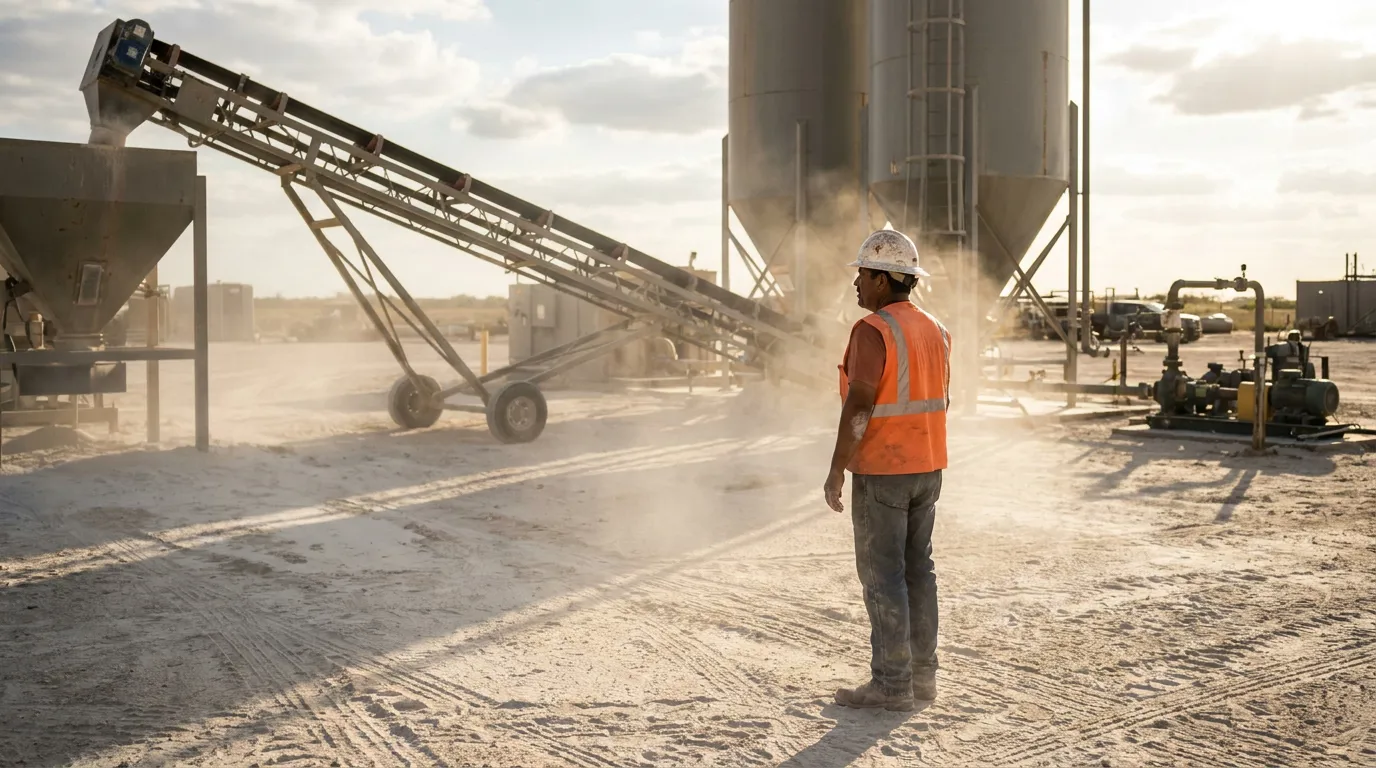
Frac sand silica exposure occurs when oil field workers inhale respirable crystalline silica, the microscopic dust released as fracking sand is moved, poured, and refilled on a well site. These particles reach deep into the lungs, causing permanent scarring known as silicosis. Under OSHA’s silica standard, 1910.1053, employers must keep worker exposure at or below 50 micrograms per cubic meter of air (µg/m³) averaged over an 8-hour shift.
Silicosis is incurable but preventable. The National Institute for Occupational Safety and Health confirms that inhaling fine respirable crystalline silica dust causes silicosis, and acute cases can develop over only a few months or years of intense exposure.
How Fracking Turns Sand Into a Lung Hazard
Frac sand is central to hydraulic fracturing, and handling it generates dangerous dust. NIOSH has documented that crystalline silica plays a major role in the fracturing process, and that moving, transporting, and refilling that sand generates considerable respirable crystalline silica. NIOSH identified seven primary points of silica dust release on hydraulic fracturing sites:
- Dust ejected from thief hatches on top of sand movers during hot loading
- Dust ejected through open side fill ports during refilling
- Dust from on-site vehicle traffic
- Dust released from transfer belts under sand movers
- Dust created as sand drops into or is agitated in the blender hopper and on transfer belts
- Dust from transfer belt operations between the sand mover and blender
- Dust from the end of the sand transfer belt (dragon’s tail)
Each of these tasks puts a worker directly in the dust cloud, shift after shift. Because the particles are invisible and often odorless, many workers never realized they were being harmed until symptoms appeared years later.
The Proof Is in the Air: What NIOSH Found at Texas Sites
Federal researchers measured this hazard at Texas sites. NIOSH collected 116 air samples at 11 hydraulic fracturing sites across five states, including Texas, and found that full-shift exposures consistently exceeded relevant occupational health limits for respirable crystalline silica. You can review NIOSH’s field study of fracking sites for the underlying data.
The most alarming finding concerns just how far past the safe limit these exposures went. NIOSH reported that 36 of the 116 samples, roughly 31 percent, exceeded the recommended exposure limit by a factor of 10 or more. At those concentrations, even half-mask air-purifying respirators would not have protected workers. The dust was so thick that ordinary masks were insufficient, which is why NIOSH recommends engineering controls like local exhaust ventilation and real air monitoring.
What Silicosis Does to Your Lungs and the Diseases Silica Causes
Silicosis attacks the lung tissue itself, and the damage generally comes in three forms. Chronic silicosis develops after long exposure. Accelerated silicosis moves faster. Acute silicosis can appear after intense short-term exposure and can be rapidly fatal. In severe cases, scarring progresses into progressive massive fibrosis (PMF), where large masses of scar tissue destroy the lung’s ability to move oxygen.
The harm rarely stops at the lungs. NIOSH has determined that crystalline silica is an occupational lung carcinogen, with evidence linking it to lung cancer, chronic obstructive pulmonary disease (COPD), chronic kidney disease, autoimmune disease, and higher tuberculosis risk. For a broader look at these risks, our overview of hazardous chemicals and oil field worker safety explains how multiple exposures can compound over a career.
Frac Sand Silica Exposure and OSHA 1910.1053: The Standard Operators Must Follow
Federal law sets a hard, measurable cap on how much silica dust workers can legally breathe. OSHA’s silica standard provides at 29 C.F.R. § 1910.1053(c) that no employee may be exposed to airborne respirable crystalline silica above 50 µg/m³, calculated as an 8-hour time-weighted average (TWA).
The rule also builds in an early warning line called the action level. Under § 1910.1053(b), the action level is 25 µg/m³ as an 8-hour TWA. Section 1910.1053(d)(1) requires employers to assess the exposure of every worker who is or may reasonably be expected to reach the action level. Protective duties kick in well before the legal limit is hit.
Beyond monitoring, the standard demands concrete protective steps. OSHA requires employers to designate "regulated areas" where silica exposure exceeds the PEL and mandates medical surveillance for exposed workers under paragraph (i). When an operator skips air monitoring, ignores regulated areas, or denies medical surveillance, that failure can become powerful evidence of negligence in a Texas oilfield injury case.
💡 Pro Tip: If you ever received respirator fit-testing, dust warnings, or medical questionnaires from an employer, those documents can help establish that the company knew silica was a hazard. Preserve anything you still have.
How Texas Law Lets Injured Oil Field Workers Hold Operators Accountable
Texas law treats a work-caused disease very differently from an everyday illness. Under Tex. Labor Code § 401.011(34), an "occupational disease" is a disease arising out of and in the course of employment that causes damage to the physical structure of the body. That definition excludes ordinary diseases of life to which the general public is exposed outside of work. Silicosis from breathing frac sand is not an ordinary disease of life.
The path to compensation generally depends on whether your employer carried workers’ compensation. An injured worker may pursue benefits through workers’ compensation if the employer subscribes, a direct negligence suit against a non-subscribing employer, a third-party claim against a negligent party who is not the employer, or some combination.
The Medical Proof Texas Requires Under Chapter 90
Texas imposes strict medical-proof requirements before a silica claim can move forward. Under Chapter 90 of the Texas Civil Practice and Remedies Code, specifically Tex. Civ. Prac. & Rem. Code § 90.004(a), a claimant asserting a silica-related injury must serve on each defendant a report from a physician board certified in pulmonary medicine, internal medicine, oncology, pathology, or, with respect to a claim for silicosis, occupational medicine, who has performed a physical examination of the exposed person and taken a detailed occupational and exposure history.
The statute also spells out the objective evidence needed to establish silicosis. Under § 90.004(a)(3), the report generally must show at least one of the following:
- A quality 1 or 2 chest x-ray read by a certified B-reader according to the ILO classification system showing bilateral predominantly nodular opacities (p, q, or r) occurring primarily in the upper lung fields with a profusion grading of 1/1 or higher (for actions filed on or after May 1, 2005)
- Pathological demonstration of classic silicotic nodules exceeding one centimeter in diameter as published in the referenced Archives of Pathology and Laboratory Medicine standard
- Progressive massive fibrosis radiologically established by large opacities greater than one centimeter in diameter
- Acute silicosis
A B-reader is a physician certified to read these x-rays under a standardized system. For silicosis specifically, the statute generally also requires the report to verify a sufficient latency period for the applicable type of silicosis and, for silicosis claims, that the exposed person has at least Class 2 or higher impairment due to silicosis, according to the American Medical Association Guides to the Evaluation of Permanent Impairment.
Who Is Responsible for Your Silica Exposure?
Responsibility for silicosis often extends beyond a single company. Depending on the facts, potentially accountable parties may include well operators who controlled the site, drilling or frac contractors who ran the sand equipment, and manufacturers of defective dust-control or respiratory equipment.
Evidence in these cases disappears fast. Air monitoring data, safety records, and equipment logs can vanish quickly, so acting promptly matters. Our firm knows how to litigate against oilfield defendants; Wyatt Law Firm recovered $6,100,000 for two plaintiffs injured in an oil-field blowout, a result that reflects how seriously we take these fights. We do not represent operators or insurers. We stand with injured Texas oil field workers.
Frequently Asked Questions
What is OSHA 1910.1053 and how does it apply to fracking? It is the federal respirable crystalline silica standard. Its permissible exposure limit bars exposure above 50 µg/m³ as an 8-hour TWA, with an action level of 25 µg/m³ that triggers employer monitoring. Because frac sand generates heavy silica dust, these duties apply to well-site work.
Can I sue if I got silicosis working a Texas oil field? Possibly. Depending on your employer’s insurance status and the facts, you may pursue workers’ compensation, a direct suit against a non-subscribing employer, or a third-party claim. A Texas silicosis claim generally requires the physician report described in Chapter 90.
How long after exposure can I file a silicosis claim in Texas? Texas generally applies a two-year deadline for personal injury claims, but silicosis is a latent disease. Courts may apply a discovery rule so the clock starts when a reasonable person would know they are sick and that work likely caused it. Prompt legal advice is important.
What medical proof do I need for a Texas silicosis claim? Chapter 90 generally requires a board-certified physician’s report supported by objective evidence, such as a quality 1 or 2 B-reader chest x-ray under the ILO system showing bilateral nodular opacities with a profusion grading of 1/1 or higher, silicotic nodules exceeding one centimeter in diameter, progressive massive fibrosis, or acute silicosis, and for silicosis claims it may also require proof of a sufficient latency period and, for non-acute forms, at least Class 2 or higher impairment according to the American Medical Association Guides to the Evaluation of Permanent Impairment.
What if my employer never did air monitoring? A failure to assess exposure, designate regulated areas, or provide medical surveillance may support a negligence argument, though outcomes depend on the full factual record.
Standing With Texas Oil Field Workers Who Cannot Get Their Breath Back
The chain is clear: frac sand silica exposure osha 1910.1053 violations create a measurable hazard, the science documents it, and Texas law gives injured workers a path to accountability. Silicosis is permanent. The exposure was preventable. And the operators who cut corners should answer for what their workers now carry in their lungs.
You Are Not Powerless. Paula Wyatt is a nationally recognized catastrophic-injury and wrongful-death trial lawyer, and our San Antonio team has spent decades fighting corporate defendants and insurers on behalf of injured Texans. If silica dust has stolen your health or taken someone you love, let Wyatt Law Firm fight for you. You focus on your health. We will carry the fight.